
The Quran is the central religious text of Islam. Muslims hold it to be the literal, unaltered word of God (Allah), revealed in Arabic to the Prophet Muhammad (PBUH) between 610 and 632 CE through the angel Gabriel (Jibril). It consists of 114 chapters (surahs) and approximately 6,236 verses (ayat), totaling roughly 77,000–78,000 words in the original Arabic.
The Quran functions as the primary source of Islamic theology, law, and daily practice. It is recited as an act of worship, not simply read as reference material.
Quick Facts
| Fact | Detail |
|---|---|
| Chapters (surahs) | 114 |
| Verses (ayat) | ~6,236 |
| Words (Arabic) | ~77,000–78,000 |
| Revelation period | 610–632 CE (23 years) |
| Original language | Classical Arabic |
| First verses revealed | Surah Al-Alaq, verses 1–5 (Quran 96:1–5) |
| Site of first revelation | Cave of Hira, near Mecca |
| First full compilation | Under Caliph Abu Bakr |
| Standardized text | Under Caliph Uthman |
| Reading divisions | 30 juz, 60 hizb, 7 manzil |
Did You Know? The Quran was not compiled into a single bound book during Muhammad's (PBUH) lifetime. It existed as a combination of memorized recitation and scattered written fragments until after his death in 632 CE.
Revelation Timeline (610–632 CE)
610 CE: Muhammad (Sallallahu alaihi wasallam) receives the first revelation in the Cave of Hira, traditionally identified as the opening verses of Surah Al-Alaq (Quran 96:1–5).
610–622 CE: The Meccan period. Revelations during this phase center on monotheism and the afterlife, forming what scholars classify as the Makki surahs.
622 CE: The Hijrah: Muhammad (PBUH) and his followers migrate to Medina.
622–632 CE: The Medinan period. Revelation shifts toward law and community governance, forming the Madani surahs.
632 CE: Muhammad (Sallallahu alaihi wasallam) dies. The Quran exists only in memorized form and scattered written fragments.
632–634 CE: Under Caliph Abu Bakr, the text is compiled into a single manuscript (mushaf) by the scribe Zaid ibn Thabit, at the urging of the companion Umar ibn al-Khattab. The master copy is entrusted to Hafsah, one of Muhammad's (PBUH) wives.
650 CE: Caliph Uthman ibn Affan commissions a standardized version to resolve regional recitation differences and distributes copies to major cities.
What Does the Word "Quran" Mean?
The word derives from the Arabic root qara'a, meaning "to read" or "to recite." Its most accurate translation is "the recitation," reflecting how the text was transmitted orally for years before existing as a complete written book.
Several related terms recur throughout Islamic scholarship:
| Term | Meaning |
|---|---|
| Mushaf | The physical written copy of the Quran |
| Tanzil | "The sending down", the act of revelation |
| Wahy | Divine revelation as a concept |
| Al-Kitab | "The Book", a Quranic self-reference |
| Furqan | "The criterion" that which distinguishes right from wrong |
Who Revealed the Quran — and Who Wrote It?
These are frequently conflated, though they refer to distinct roles.
Revealer: In Islamic belief, God is the source of the Quran's content and exact wording.
Transmitter: The angel Gabriel (Jibril) delivered the revelation to Muhammad (Sallallahu alaihi wasallam).
Recipient: Muhammad (Sallallahu alaihi wasallam) received the revelations but is not considered their author. Islamic theology explicitly rejects the idea that he composed the text, a position reinforced by his traditional description as ummi (unlettered), unable to read or write (Quran 29:48).
Scribes: Companions recorded verses as they were revealed, using palm-leaf stalks, flat stones, and parchment. The ordered, bound compilation came only after Muhammad's (Sallallahu alaihi wasallam) death.
Why Was the Quran Revealed?
Islamic teaching identifies several core purposes behind the revelation:
- To reaffirm the oneness of God after what Islamic tradition regards as centuries of theological drift in earlier communities
- To provide moral and legal guidance for individual and communal life
- To warn of accountability in the afterlife and outline a path toward salvation
- To serve as a final revelation, confirming and correcting earlier scriptures given to Moses and Jesus
How Was the Quran Preserved?
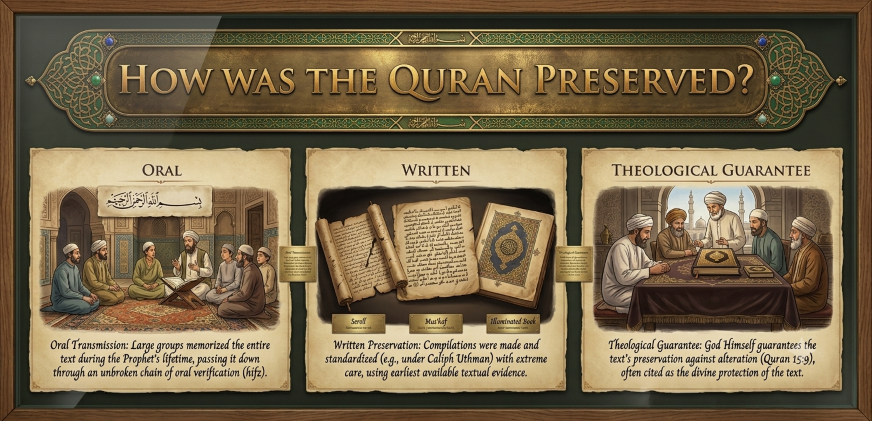
Islamic scholarship identifies two parallel preservation methods.
Oral transmission: Large numbers of Muhammad's (Sallallahu alaihi wasallam) companions memorized portions some the entire text during his lifetime. This practice of memorization (hifz) has continued unbroken; millions of hafiz worldwide today serve as a continuing verification against textual alteration.
Written transmission: The Abu Bakr compilation, followed by the Uthmanic standardization, established a single fixed reference. Early manuscript evidence supports early textual stability: the Birmingham manuscript, for example, has been radiocarbon-dated to within decades of Muhammad's (Sallallahu alaihi wasallam) life, though academic discussion continues regarding dating methodology and minor regional recitation variants (qira'at).
Muslims also cite a theological guarantee of preservation. Quran 15:9 states that God Himself preserves the text, a concept often referenced through the term Lawh al-Mahfuz, "the Preserved Tablet."
How Is the Quran Structured?
Surahs (Chapters)
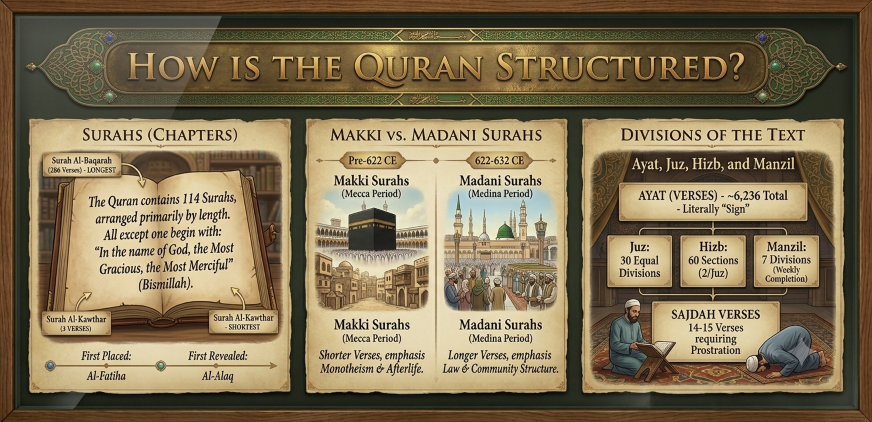
The Quran contains 114 surahs, arranged primarily by length rather than by the order of revelation. Every surah except one (At-Tawbah) opens with the phrase "In the name of God, the Most Gracious, the Most Merciful."
| Fact | Surah |
|---|---|
| Longest | Al-Baqarah ("The Cow") — 286 verses |
| Shortest | Al-Kawthar — 3 verses |
| First by placement | Al-Fatiha ("The Opening") |
| First revealed | Al-Alaq |
Makki vs. Madani Surahs
Surahs are also classified by the period in which they were revealed. This classification directly affects interpretation.
- Makki surahs (Mecca, pre-622 CE): shorter verses; emphasis on monotheism and the afterlife
- Madani surahs (Medina, 622–632 CE): longer verses; emphasis on law and community structure
Ayat, Juz, Hizb, and Manzil
- Ayat: individual verses, approximately 6,236 in total; the term literally means "sign"
- Juz: 30 equal divisions, enabling a complete reading across 30 days (commonly used during Ramadan)
- Hizb: 60 sections, two per juz
- Manzil: 7 divisions, used in some traditions for weekly completion
- Sajdah verses: 14–15 specific verses requiring physical prostration when recited or heard
What Language Is It In?
The Quran was revealed in Classical Arabic, specifically the dialect of the Quraysh tribe. Islamic theology holds that the precise Arabic wording is itself part of the revelation, not merely a vehicle for meaning. For this reason, formal prayer recitation is conducted in Arabic regardless of the worshiper's native language.
Is a Translation Still "the Quran"?
In strict Islamic terms, no. Translations are classified as interpretations of meaning (tafsir al-ma'ani), not the Quran itself. They remain essential for study and understanding.
| Translation | Translator/Editor | Notable for |
|---|---|---|
| The Clear Quran | Dr. Mustafa Khattab | Modern, accessible English |
| The Study Quran | Seyyed Hossein Nasr (ed.) | Extensive scholarly commentary |
| Sahih International | Committee | Literal rendering, widely cited |
| Oxford World's Classics | M.A.S. Abdel Haleem | Academic, readable prose |
What Does the Quran Teach?
The Quran's teachings span several distinct thematic categories. Each is treated separately below for clarity.
Monotheism (Tawhid)
The Quran's most consistently repeated theme is tawhid, the absolute oneness of God. Surah Al-Ikhlas (Quran 112:1–4) is frequently cited as the clearest concise statement of this doctrine.
Prophets and Shared Figures
The Quran discusses many figures found in Jewish and Christian scripture, including Adam, Noah, Abraham, and Moses, generally reframed within an Islamic theological structure. Jesus (Isa) appears by name in more than 20 verses, including a detailed account of his birth to the Virgin Mary (Quran 19:16–34). He is honored as a prophet and the Messiah, but the Quran explicitly rejects his divinity and the doctrine of the Trinity (Quran 5:116).
The Unseen World
The Quran describes jinn beings created from "smokeless fire" (Quran 15:27), distinct from both angels and humans, and possessing free will. Surah Al-Jinn (Quran 72) is devoted entirely to this subject.
The Afterlife
Paradise (Jannah) and hell (Jahannam) are described in extensive, sensory detail throughout the text, tied consistently to themes of moral accountability and final judgment.
Law and Ethics
Verses addressing marriage, inheritance, commerce, and criminal justice form a foundational though not sole source of Islamic jurisprudence (sharia), alongside the Sunnah.
Quran vs. Bible
| Feature | Quran | Bible |
|---|---|---|
| Religion | Islam | Judaism (Old Testament) / Christianity (Old + New Testament) |
| Believed origin | Single revelation, one prophet, 23 years | Multiple human authors across centuries |
| Original language | Classical Arabic | Hebrew, Aramaic, Greek |
| Structure | 114 surahs | 66–73 books (tradition-dependent) |
| View of Jesus | Prophet and Messiah; not divine | Son of God; central to salvation |
| Compiled | ~7th century CE | Old Testament composed over ~1,000 years earlier; New Testament ~1st century CE |
The Quran is not older than the Bible. Both the Hebrew Bible and the New Testament predate it, the Hebrew Bible by close to a millennium in parts.
Quran, Hadith, and Sunnah
These three terms are related but distinct, and confusing them is common.
- Quran: Believed to be God's direct, verbatim speech
- Hadith: Individually recorded reports of Muhammad's (Sallallahu alaihi wasallam) sayings and actions, compiled later and graded by authenticity (sahih, hasan, da'if)
- Sunnah: The broader example and practice of Muhammad (Sallallahu alaihi wasallam), evidenced through hadith
Muslims treat the Quran as the primary source of guidance and the Sunnah as the essential framework for interpreting and applying it.
How Muslims Use the Quran Today
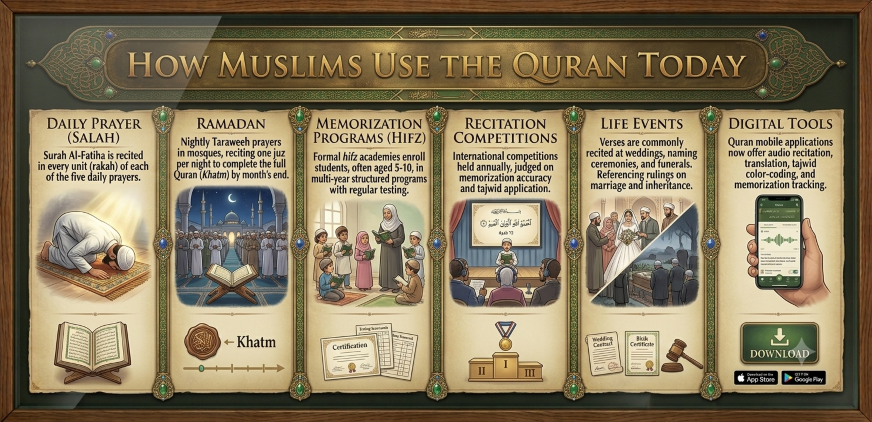
The Quran is embedded in daily and seasonal religious practice through specific, structured routines:
Daily prayer (salah): Surah Al-Fatiha is recited in every unit (rakah) of each of the five daily prayers, making it one of the most frequently recited passages in the world.
Ramadan: Many mosques conduct nightly taraweeh prayers during Ramadan, reciting one juz per night so the congregation completes the full Quran (khatm) by the month's end.
Memorization programs (hifz): Formal Quran memorization schools (often called madrasas or hifz academies) enroll students — commonly starting between ages 5 and 10 — in multi-year structured memorization programs, with regular testing by qualified instructors.
Recitation competitions: International Quran recitation competitions are held annually in numerous Muslim-majority countries, judged on both memorization accuracy and tajwid application.
Life events: Verses are commonly recited at weddings, naming ceremonies, and funerals, and portions are referenced in religious rulings on marriage and inheritance.
Digital tools: Quran mobile applications now offer audio recitation, verse-by-verse translation, tajwid color-coding, and memorization tracking reflecting continued adaptation of traditional practice to modern formats.
Did You Know? Surah Al-Fatiha is recited a minimum of 17 times daily by observant Muslims performing the five daily prayers, making it likely the most repeated text in religious practice worldwide.
Recitation and Study
Several disciplines govern how the Holy Quran is read and interpreted:
- Tajwid: The rules of correct pronunciation and articulation during recitation
- Tarteel: Slow, deliberate recitation, distinct from rapid reading
- Qira'at: The accepted recitation styles (traditionally seven, sometimes counted as ten), reflecting minor regional pronunciation variants preserved since the early compilation
- Tafsir: Scholarly exegesis providing historical and legal context for interpretation
Common Misconceptions
Muhammad (Sallallahu alaihi wasallam) wrote the Quran: Islamic theology explicitly rejects this. He is considered a recipient of revelation, not its author, and is traditionally described as unable to read or write.
Quran has no real structure: The Quran has a defined chapter-and-verse system, along with additional reading divisions (juz, hizb, manzil) designed for structured study and memorization.
Only Arabic speakers can read it: Translations are widely used for study. Muslims regard the Arabic text as uniquely significant to formal worship, but this does not restrict study in translation.
Arranged chronologically: It is not. Surahs are arranged primarily by length, not by the order in which they were revealed.
Non-Muslims cannot read it: There is no restriction on non-Muslims reading a translation or the Arabic text for study. Some traditions request ritual purity before physically handling an Arabic mushaf, a devotional custom rather than a prohibition on reading.
Common Beginner Mistakes
- Reading the Quran cover-to-cover in surah order, expecting a linear narrative
- Skipping historical context (asbab al-nuzul) on legally or historically dense verses
- Assuming surah order reflects revelation order
- Starting with Al-Baqarah, the longest and one of the most legally dense surahs, rather than shorter thematic surahs
Why Is the Quran Still Memorized Today?
Full memorization of a 77,000-word text might seem unnecessary in an age of print and digital search, yet the practice has not declined if anything, formal hifz programs have expanded globally. Several factors explain why.
Oral tradition predates the written text: The Quran was preserved through memorization before it existed as a complete book. Memorization is not a later devotional add-on; it is the original transmission method, and the tradition of learning it by heart has simply continued unbroken for 1,400 years.
Functions as a preservation safeguard: Because millions of hafiz around the world hold the same text in memory, any printing error or textual alteration would be immediately detectable against a living, independent record, a built-in check that predates and now supplements the written manuscript tradition.
Foundational to Islamic education: Historically, memorizing some or all of the Quran was the first stage of formal education across the Islamic world, taught in institutions called maktab or kuttab before a student advanced to grammar, law, or theology. That structure still shapes religious education today in many countries.
Required for worship, not optional study: Recitation from memory rather than reading from a page — is standard in the five daily prayers and in leading congregational prayer (imamate). A working level of memorization is functionally necessary for religious practice, not just academic interest.
Operates at a global scale: Full-hifz academies operate across South Asia, the Middle East, Southeast Asia, Africa, and Muslim communities in Europe and North America. Countries such as Indonesia where Arabic is not a native language nonetheless produce large numbers of hafiz annually, demonstrating that the practice is sustained by devotional commitment rather than linguistic familiarity. International competitions, such as the Dubai International Holy Quran Award, draw memorizers from dozens of countries each year, judged on both accuracy and tajwid.
How Long Does It Take to Memorize the Quran?
There is no single answer — completion time depends heavily on age, schedule intensity, and prior Arabic exposure. Approximate ranges reported by hifz institutions:
| Path | Typical Duration | Notes |
|---|---|---|
| Full-time child student (dedicated hifz madrasa) | 1–3 years | Several hours daily, often replacing or supplementing general schooling |
| Part-time adult learner | 3–7+ years | Evenings/weekends alongside work or other study |
| Intensive residential program | Under 1 year | Rare; requires many hours daily and prior Quranic reading fluency |
Two factors matter more than raw memorization speed. The first is muraja'ah (revision) memorizing the text once is not the same as retaining it permanently, and hafiz typically continue structured review for years, sometimes for life, to prevent forgetting. The second is prior fluency in reading Arabic script (even without full comprehension); students who can already read Quranic Arabic accurately tend to memorize substantially faster than those learning the script and the text simultaneously.
How the Quran Influenced Civilization
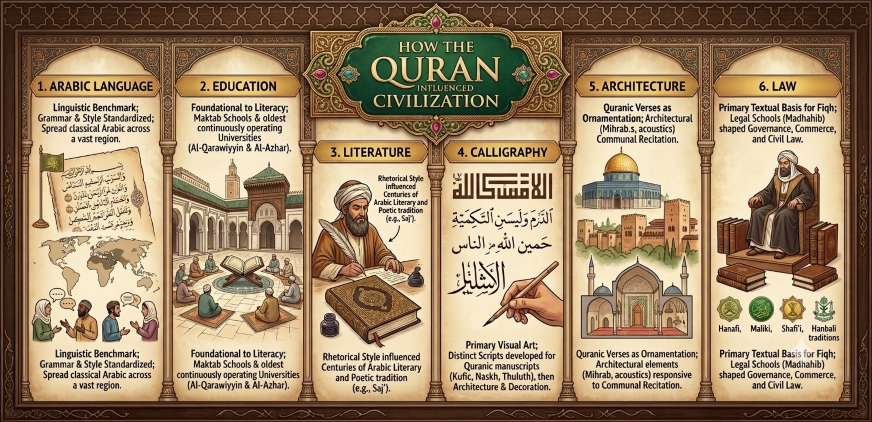
The Quran's influence extends well beyond religious practice, shaping several fields across the history of the Islamic world.
1. Arabic language: The Quran functions as the linguistic benchmark for Classical Arabic; its grammar, vocabulary, and style became the standard against which formal Arabic has been measured for over a millennium, contributing directly to the spread and standardization of the language across a geographically vast and linguistically diverse region.
2. Education: Quran memorization schools (maktab, kuttab) formed the base of literacy education across much of the historical Islamic world, and Quranic study was foundational to institutions that grew into some of the world's oldest continuously operating universities including the University of Al-Qarawiyyin in Fez, Morocco (founded 859 CE) and Cairo's Al-Azhar (founded 970 CE), both of which began as centers of Quranic and religious learning before expanding into broader scholarship.
3. Literature: Quranic rhetorical style including its distinctive rhymed prose (saj') influenced centuries of subsequent Arabic literary and poetic tradition, shaping prose style well beyond religious writing.
4. Calligraphy: Because Islamic tradition generally discourages figurative depiction in religious art, Arabic calligraphy developed as the primary visual art form associated with the faith, largely in service of reproducing the Quran itself. Distinct scripts including Kufic, Naskh, and Thuluth were developed specifically for Quranic manuscripts and later extended into architectural and decorative use.
5. Architecture: Quranic verses appear as structural ornamentation in some of the most significant buildings in Islamic history, including the Dome of the Rock in Jerusalem and the Alhambra in Granada. Mosque design itself from the mihrab's orientation toward Mecca to acoustic considerations for recitation developed in direct response to how the Holy Quran is read and heard in communal worship.
6. Law: Quranic verses form the primary textual basis for Islamic jurisprudence (fiqh), which developed into distinct legal schools (madhahib) including the Hanafi, Maliki, Shafi'i, and Hanbali traditions in Sunni Islam that shaped governance, commerce, and civil law across a succession of Islamic empires and continue to inform legal systems in parts of the world today.
A Beginner's Roadmap
For readers approaching the Quran for the first time:
- Choose a reputable translation: Rather than a rigid, overly literal one. Abdel Haleem's Oxford translation and The Clear Quran are commonly recommended starting points.
- Avoid reading strictly cover-to-cover: Many newcomers begin with shorter, self-contained surahs Al-Fatiha, Al-Ikhlas, Ya-Sin — rather than the lengthy, legally focused Al-Baqarah.
- Pair reading with tafsir (commentary): For historical context, particularly for verses referencing specific 7th-century events.
- Note the Makki/Madani distinction: While reading, since it shapes the tone and legal weight of a given passage.
